
Table of Contents
A Step-by-Step Guide for HR Leaders
By Amy Perez | Compensation Equity & Compliance | Last updated April 2025
1. What Is a Pay Equity Audit, and Why Does It Matter?
| DEFINITION PAY EQUITY AUDIT A pay equity audit is a structured, data-driven analysis of an organization’s compensation practices to determine whether employees in comparable roles are paid equitably regardless of gender, race/ethnicity, age, or other protected characteristics. The process identifies unexplained pay gaps and informs targeted remediation. |
Pay equity is no longer a best practice. It is rapidly becoming a legal requirement. More than a dozen U.S. states now mandate pay data reporting or pay range disclosure, and federal enforcement of pay discrimination law under Title VII and the Equal Pay Act has intensified.
The business case is equally compelling. Organizations with transparent, equitable pay practices report stronger talent attraction, lower turnover, and higher employee trust. Those that discover gaps during litigation rather than through internal review face significant legal, financial, and reputational exposure.
| KEY TAKEAWAY A pay equity audit is not about proving that no gaps exist. It is about understanding where gaps exist, why they exist, and what the organization intends to do about them. Proactive audits conducted with counsel are generally protected by attorney-client privilege. Reactive ones are not. |
Why Organizations Conduct Pay Equity Audits (% citing as a primary driver)
| Legal/compliance risk | 78% |
| Talent retention | 65% |
| Pay transparency laws | 61% |
| Employee trust | 54% |
| Proactive DEI goals | 48% |
Source: WorldatWork Compensation Practices Survey
2. How to Prepare for a Pay Equity Audit
Before running any analysis, organizations need to make four foundational decisions.
Involve legal counsel from the start
Pay equity audits conducted under attorney direction may qualify for attorney-client privilege, protecting findings from discovery in litigation. Engage employment counsel before collecting or analyzing data, not after.
Decide on internal vs. third-party analysis
Internal audits are lower cost and can run on a more frequent cycle. Third-party audits conducted by a compensation consultant or law firm carry greater external credibility and are more defensible if challenged. Many organizations do both: internal analysis quarterly, third-party review annually.
Establish a clear project charter
Define scope, data sources, timeline, roles and responsibilities, and how findings will be reviewed and acted on before data collection begins. Ad hoc audits with unclear ownership rarely result in meaningful action. Assign a named project lead, identify which HRIS systems will be the data source of record, and set a firm decision date for when remediation recommendations will go to leadership.
Choose your analysis methodology
| Method | What It Measures | Best For |
|---|---|---|
| Unadjusted gap analysis | Raw pay difference between groups (e.g., women vs. men) | Public reporting, high-level benchmarking |
| Adjusted (regression-based) analysis | Pay gap after controlling for job title, level, tenure, geography, and performance | Internal audit, legal defensibility, targeted remediation |
| Market benchmarking comparison | How employee pay compares to external market percentiles by group | Identifying structural underpayment patterns |
| IMPORTANT An unadjusted gap is not evidence of discrimination, but it is a signal. Most rigorous audits run both methods: the unadjusted gap captures what employees experience, while the adjusted gap isolates what cannot be explained by legitimate pay factors. |
3. Step 1: Define Your Audit Scope
Pay equity audits can be scoped narrowly (a single department) or broadly (the entire organization). Most HR leaders should start with a full-organization pass to identify where the greatest exposure lies, then prioritize deeper analysis on flagged areas.
| Scoping Dimension | Options to Consider |
|---|---|
| Employee populations | All employees, full-time only, specific job families or levels |
| Pay components | Base salary only; base + bonus; total cash; total compensation |
| Protected characteristics | Gender, race/ethnicity, age (40+); prioritize by legal risk and data availability |
| Time period | Point-in-time snapshot or longitudinal (track gaps over 2-3 years) |
| Geographic scope | National, by region, or by specific metro; location affects pay benchmarks significantly |
It is also worth deciding upfront whether you will analyze pay equity at a point in time or longitudinally across two to three years. Longitudinal analysis is more powerful because it can reveal whether gaps are widening or narrowing over time and whether specific events like reorganizations or merit cycles are creating or closing disparities. Most organizations start with a point-in-time snapshot and add longitudinal analysis in subsequent cycles.
| KEY TAKEAWAY One of the most common scoping errors is using job titles alone to define comparable work. Pay equity law uses a broader standard: employees doing substantially similar work, requiring similar skill, effort, and responsibility, under similar conditions, should be paid equitably regardless of exact title. |
4. Step 2: Collect and Clean Your Compensation Data
Data quality is the single most important determinant of audit reliability. Most organizations discover meaningful data gaps the first time they attempt to compile a complete compensation dataset.
Core data fields required
| Data Field | Why It’s Needed | Common Issues |
|---|---|---|
| Job title / job code | Defines comparable work groups | Too many titles; inconsistent titling across managers |
| Job level / grade | Controls for experience and seniority | Missing for many roles, especially early-career |
| Base salary | Primary compensation variable | Verify annualized vs. actual |
| Bonus / variable pay | Required for total cash analysis | Often missing or inconsistently tracked |
| Hire date / tenure | Controls for experience | Gaps for rehires, acquisitions |
| Performance rating | Legitimate pay factor | Often not available or inconsistently applied |
| Gender / race/ethnicity | Protected characteristics | May require voluntary self-identification |
| Location (city/metro) | Geographic pay adjustment | Remote workers may lack a clear location |
| DATA QUALITY WARNING Job title inconsistency is the most common data problem in pay equity audits. If your organization has 600 employees and 400 unique job titles, your data is not ready for analysis. Invest time normalizing job titles into a standardized job architecture before running any gap analysis. |
Data cleaning checklist
- Verify all salaries are expressed in the same format — annualized and full-time equivalent
- Flag and investigate outliers (salaries more than 2 standard deviations from the group mean)
- Remove or separately analyze employees on leave, part-time status, or in transition roles
- Confirm that job levels are assigned consistently across departments and managers
- Document all data exclusions and the rationale for each — auditors and counsel will ask
5. Step 3: Identify Legitimate Pay Factors
Pay equity analysis requires distinguishing between pay gaps explained by legitimate, business-relevant factors and gaps that remain unexplained and therefore potentially discriminatory.
Legitimate pay factors that can explain pay differences include job-related skills or certifications, years of experience, tenure with the organization, geographic location, performance ratings (when applied consistently), and shift differentials.
In a regression-based pay equity analysis, these factors become the independent control variables in a statistical model. The model estimates what each employee would be expected to earn based on those factors alone. The residual (the difference between expected and actual pay) is what the audit focuses on. A well-specified model controls for enough factors to be credible, but avoids over-controlling in ways that mathematically eliminate real gaps.
| CRITICAL DISTINCTION Negotiation history and prior salary are NOT legitimate pay factors in an increasing number of jurisdictions. More than 20 states and localities have enacted salary history bans. Using these factors to justify pay differences is legally risky and analytically unsound, as prior pay disparities simply replicate historical inequities into the current organization. |
| Q: What if our performance ratings are themselves biased? A: This is a real risk. Research consistently shows that performance ratings can reflect evaluator bias rather than objective performance, particularly for women and employees of color. If performance data is included in your model, run a separate analysis to confirm ratings are distributed equitably across demographic groups. If they are not, including ratings as a control variable may mask discrimination rather than reveal it. |
6. Step 4: Run the Pay Equity Analysis
With clean data and a defined set of control variables, you are ready to run the analysis. Most rigorous audits use both approaches below in combination.
Unadjusted gap analysis
Calculate the mean and median pay for each demographic group within a comparable work group, then compute the raw pay ratio. This is the number most commonly reported publicly.
| Comparable Group | Women Median | Men Median | Raw Pay Gap | Gap % |
|---|---|---|---|---|
| Software Engineer III | $118,000 | $124,000 | -$6,000 | -4.8% |
| Marketing Manager | $92,000 | $99,000 | -$7,000 | -7.1% |
| Financial Analyst II | $84,000 | $87,000 | -$3,000 | -3.4% |
| Senior Sales Rep | $105,000 | $118,000 | -$13,000 | -11.0% |
Example only. Hypothetical data for illustration purposes.
Regression-based adjusted analysis
A multiple regression model estimates the expected salary for each employee based on the legitimate control variables. The model then produces an adjusted pay ratio: the gap that remains after controlling for those factors. A statistically significant negative coefficient on a demographic variable means that, holding all other factors equal, that group is paid less and the gap cannot be explained by the model’s controls.
| Threshold | Meaning | Typical Action |
|---|---|---|
| p < 0.05 | Statistically significant at 95% confidence | Flag for review; gap is unlikely to be random |
| p < 0.01 | Statistically significant at 99% confidence | Strong signal; prioritize for remediation |
| Effect size > 2% | Practically significant gap | Warrants action even if marginal on statistical test |
| n < 30 per group | Insufficient sample size | Interpret with caution; use individual review instead |
7. Step 5: Interpret Findings and Develop a Remediation Plan
Raw analysis output is not a remediation plan. Evaluate each flagged gap through this three-question framework before deciding how to respond. The goal is to separate gaps that are explained by legitimate differences in employee characteristics from gaps that represent real, unexplained pay disparities that the organization has an obligation to address.
| 1 – Can we explain it? | Does the gap disappear, or shrink materially, when we control for legitimate factors? If the adjusted gap is near zero, the raw gap is likely explained by job-related differences. If it remains, it requires further scrutiny. |
| 2 – Should we have explained it? | Even if a gap is explained by a control variable, ask whether that variable reflects a legitimate business rationale or structural bias. Explained gaps can still be inequitable. |
| 3 – What do we do about it? | Determine whether remediation is warranted, feasible, and appropriately prioritized. Not every gap requires immediate salary adjustment. Some may require changes to HR processes or structural policies. |
Remediation framework
| Gap Category | Recommended Response | Timeline |
|---|---|---|
| Statistically significant unexplained gap, >5% | Immediate salary adjustment for affected employees | Within current comp cycle |
| Unexplained gap, 2-5% | Targeted manager review; salary adjustment or merit priority | Within 6 months |
| Explained gap: structural factor | Address root cause (promotion practices, job architecture) | 6-18 months |
| Near-zero gap, high-risk population | Monitor closely in next cycle | Ongoing |
| REMEDIATION RULE Pay equity remediation should only go in one direction: up. Never reduce pay to close a gap. If you cannot afford to bring underpaid employees up immediately, document that fact, develop a phased plan, and begin with the highest-gap cases. |
| KEY TAKEAWAY Present remediation as a cost-per-employee-retained investment. The cost of losing a single mid-career employee, factoring in recruiting, onboarding, and lost productivity, typically ranges from 50% to 200% of annual salary. Pay equity remediation almost always pencils out against that benchmark. |
8. Step 6: Document, Communicate, and Monitor
A pay equity audit is not a one-time event. It is the beginning of an ongoing program. Lock in documentation, communicate findings appropriately, and build a monitoring infrastructure to sustain progress.
Documentation requirements
- Full methodology documentation: data sources, exclusions, control variables, statistical approach
- Findings summary: gap analysis outputs, significance thresholds applied, interpretation rationale
- Remediation log: who was adjusted, by how much, when, and why, with a manager approval trail
- Attorney review record if privileged: engagement letter, counsel involvement, privilege assertion
Communication by audience
| Audience | What to Share |
|---|---|
| Board / Compensation Committee | High-level gap summary, remediation cost, legal risk assessment |
| Senior Leadership | Methodology overview, aggregate findings by function, budget impact |
| People Managers | That a review occurred and adjustments were made where warranted |
| Employees receiving adjustments | That a pay equity review was conducted and their pay was adjusted as a result |
| All employees | That the organization conducts regular pay equity reviews |
Building a continuous monitoring program
- Pre-offer review: flag any offer below the 40th percentile for the role before extending
- Annual merit cycle review: run equity screen before finalizing merit increase recommendations
- Promotion review: audit post-promotion pay to confirm equity is maintained after level changes
- Annual full audit: repeat the complete analysis annually, or at minimum every two years
Building monitoring into existing HR workflows is the most sustainable approach. Organizations that treat pay equity as a standalone annual project consistently fall behind those that embed equity checks into offer approvals, merit cycles, and promotion reviews. The goal is a system where pay gaps are caught and corrected continuously rather than discovered in bulk during an audit cycle.
9. Common Mistakes in Pay Equity Audits
| Mistake | Why It’s a Problem | Better Approach |
|---|---|---|
| Starting without legal counsel | Findings may not be privileged; documentation becomes discoverable in litigation | Engage employment counsel before collecting data |
| Using job title as the only comparator | Misses the ‘substantially similar work’ legal standard | Build a job architecture that groups roles by actual work content |
| Including negotiation history as a control | Illegal in many jurisdictions; perpetuates historical inequities | Remove prior salary and negotiation outcome from the model |
| Analyzing only gender, ignoring race/ethnicity | Intersectional gaps, particularly for women of color, are often larger and more legally exposed | Run analysis for both separately and at the intersection |
| Treating the audit as a one-time event | Gaps re-emerge from new hires, promotions, and merit cycles within 12-24 months | Build equity checks into recurring HR processes |
| Remediating without fixing root causes | Gaps return in the next audit cycle | Address the process or structural issue driving the gap, not just the symptom |
The underlying theme across these mistakes is treating pay equity as a compliance checkbox rather than a business priority. Organizations that get the most value from pay equity audits are those that invest in clean data infrastructure, engage counsel early, and commit to acting on what they find, even when the remediation cost is uncomfortable.
10. How LaborIQ Supports Pay Equity Analysis
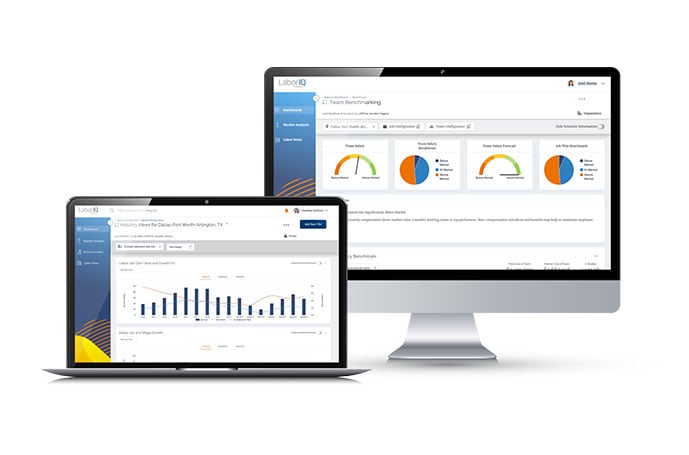
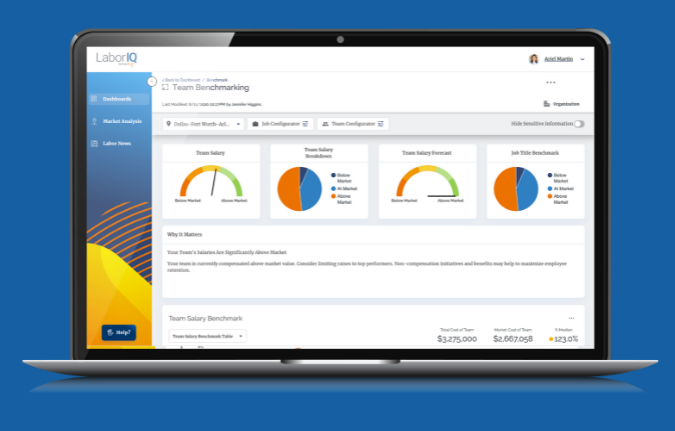
LaborIQ provides the compensation data infrastructure HR leaders need to run a rigorous, defensible pay equity audit, from initial benchmarking through remediation modeling and ongoing monitoring.
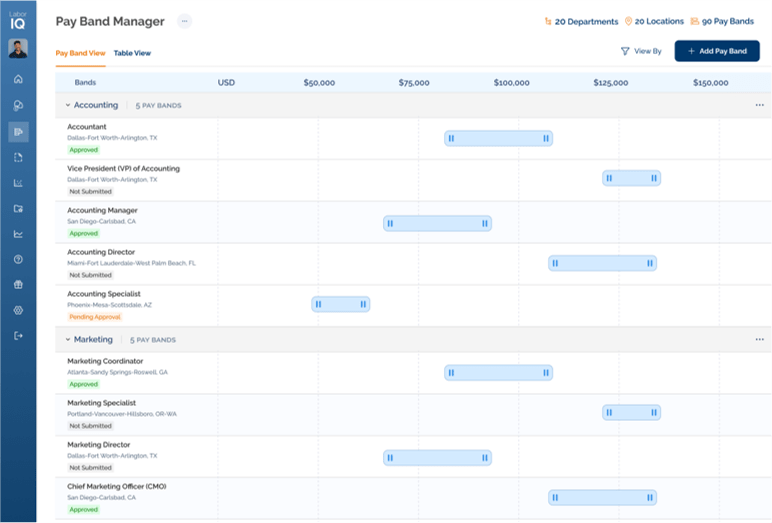
| LABORIQ PLATFORM Pay Equity Analysis Built for HR Leaders LaborIQ gives you the compensation data infrastructure to run a rigorous pay equity audit, spanning benchmarking, regression analysis, and remediation planning. ✓ Real-time salary benchmarks at the 25th, 50th, 75th, and 90th percentiles ✓ Pay equity analysis by gender, race/ethnicity, and role ✓ Compa-ratio reporting and geographic pay adjustment ✓ Remediation cost modeling and audit-ready reporting → Request a Free Demo at laboriq.co/request-demo |
| Audit Phase | How LaborIQ Helps |
|---|---|
| Scoping and benchmarking | Access real-time salary percentiles for every role to establish market anchors before running internal analysis |
| Gap identification | Compare employee salaries to 25th/50th/75th percentile benchmarks by role, level, and geography, segmented by demographic group |
| Remediation modeling | Model the cost of bringing underpaid employees to specific percentile targets, by role, function, or demographic group |
| Ongoing monitoring | Set alerts for new hires or post-promotion salaries that fall below defined percentile thresholds |
Unlike annual salary surveys, which can reflect market conditions from 12 to 18 months ago, LaborIQ’s data is continuously updated so your pay equity benchmarks reflect the market as it is today. That matters in pay equity analysis because market underpayment and internal inequity often move together: roles that drift below market benchmarks tend to disproportionately affect the same demographic groups that internal audits flag for unexplained gaps. Having a compensation platform that surfaces both dynamics simultaneously shortens the time from audit to action.
11. Frequently Asked Questions
| Q: How long does a pay equity audit take? A: For most mid-sized organizations (500-2,000 employees), a first-time audit typically takes 8-16 weeks from data collection through remediation planning. The majority of that time is spent on data cleaning and job architecture normalization, not the analysis itself. |
| Q: What is a gender pay gap analysis, and is it the same as a pay equity audit? A: A gender pay gap analysis is a specific type of pay equity audit focused on pay differences between men and women. It is one component of a comprehensive pay equity audit, which also examines race/ethnicity, age, and other protected characteristics. Many organizations begin with gender pay gap analysis because the data is most available, then expand scope in subsequent cycles. |
| Q: What does compensation equity mean versus pay equity? A: Compensation equity is a broader concept encompassing not just base salary equity (pay equity) but also equitable access to variable pay, equity grants, benefits, and advancement opportunities. Pay equity audits focused on salary and cash compensation are the most common starting point. |
| Q: Do we have to share results publicly? A: Not in most U.S. jurisdictions. The U.S. currently has no federal requirement to publicly disclose pay equity audit findings. Voluntary disclosure of high-level findings can be a competitive differentiator for talent attraction, though it should be reviewed by counsel first. |
| Q: How often should we run a pay equity audit? A: At minimum, annually, aligned to your compensation cycle. In fast-moving talent markets such as technology, healthcare, and finance, quarterly validation is worth the effort. Markets can shift 5-15% in a single year for high-demand roles, meaning a band set equitably today can drift out of alignment without any action on your part. |
Amy Perez – Author
Compensation Research & Strategy · LaborIQ
The LaborIQ editorial team is composed of compensation analysts, HR practitioners, and workforce economists. Our content is grounded in real-time labor market data and reviewed by certified compensation professionals. LaborIQ is a compensation intelligence platform helping organizations benchmark, plan, and optimize pay with confidence.