
Ask an AI assistant what a role pays and you will get an answer. It will be specific, it will be formatted like a benchmark, and it will arrive in the same confident tone the assistant uses for everything else. Some of the time it will be close. The problem is that nothing about the answer tells you which time this is.
This is not a general complaint about the technology. The failures are specific, there are four of them, and they have different causes. Two of them are solved by connecting the assistant to a live data source. The other two are not, and they are the ones most likely to be missed.
What you will find in this guide
- What a wrong salary answer looks like
- Failure one: the answer describes a market that has moved
- Failure two: no source travels with the number
- Failure three: the job it priced is not your job
- Failure four: every answer arrives in the same voice
- What connecting live data fixes, and what it does not
- The two problems that stay yours
- How to ask so the failures become visible
- How LaborIQ supports AI-assisted pay questions
- Frequently asked questions
What a wrong salary answer looks like
A wrong salary answer does not look wrong. That is the whole difficulty. It arrives formatted as a benchmark, with a plausible figure and often with a percentile range attached, and it reads exactly like the output of a compensation platform.
| COMMON FAILURES A hiring manager asks an assistant what a role pays in their city, gets a figure, and repeats it in a meeting. By the time it reaches an offer, nobody in the conversation remembers that the number came from a chat window rather than from the compensation team. The figure is now being defended as though it were a benchmark. |
The mechanism behind this is worth stating plainly. A language model generates text that fits the patterns it learned. When you ask for a salary, it produces the kind of figure that would plausibly appear in that context. Sometimes that reproduces a real benchmark closely, because the pattern was learned from real benchmarks. Sometimes it produces a figure that has the shape of a benchmark and no relationship to one.
| What travels with the figure | From a compensation platform | From a model |
| A job definition | The role it was matched to | Nothing |
| A market | The geography it was priced in | Whatever the phrasing implied |
| A date | When it was computed | Nothing |
| A method | How the figure was derived | Nothing |
| A way to check it | A record you can open | Nothing |
We have written before about the risks of leaning on AI-generated compensation data. This piece takes the next step and separates the failures, because the fix for each one is different and treating them as a single problem leads to the wrong response.
Failure one: the answer describes a market that has moved
A model learns from text gathered up to a fixed point. Everything it knows about pay describes the market as it stood then. It has no mechanism for noticing that time has passed, and it will answer a question about this year with knowledge from an earlier one without signaling the gap.
For most subjects this ages gracefully. Compensation does not. Wage growth moves, specific job families move faster than the aggregate, and geographic differentials shift as hiring patterns change. A figure that was accurate when the model was built can be materially off by the time you ask, and the drift is largest in exactly the roles where hiring is most competitive.
| What you asked | What the model has | What you receive |
| What does this role pay now | Patterns from text gathered up to a fixed date | A figure describing the market as it was then |
| What is the current range | No concept of the current date | A range with no time stamp on it |
| Has this changed recently | No before and after to compare | A plausible narrative rather than a measurement |
The gap is also asymmetric in a way that works against you. Models are trained on text that skews toward whatever was widely published, and salary content is published most heavily for common roles in large markets. For those, an answer may be roughly serviceable. For a specialist role in a mid-size metro, the model has thin material to work from and will still answer at the same length and with the same assurance. The quality of the answer varies enormously and the presentation of it does not vary at all.
Failure two: no source travels with the number
When a compensation platform gives you a figure, the figure is attached to something: a job definition, a market, a collection period, a method. When a model gives you a figure, there is nothing behind it to inspect. The number is the output of a generation process, not a retrieval from a record.
This has a consequence that goes beyond the individual answer. Without provenance you cannot distinguish an answer the model has strong grounds for from one it has weak grounds for, because both are delivered identically. You also cannot audit the decision later, which matters a great deal if a pay decision is ever questioned.
| CRITICAL DISTINCTION A citation is not the same as provenance. A model can produce a source that looks authoritative and was generated alongside the figure rather than consulted for it. The test is not whether a source is named. It is whether you can follow the source and find the number. |
There is a practical test that separates the two cases in about fifteen seconds. Ask the same question twice, in two sessions, worded slightly differently. A figure that came from a record will be the same figure both times. A figure that was generated will usually drift, because the wording changed which patterns were most active. Stability under rephrasing is not proof of accuracy, but instability is a reliable sign that nothing was looked up.
Failure three: the job it priced is not your job
Every salary question contains a hidden matching step. You name a title, and something has to decide which job that title refers to. A model resolves it to whatever the title most commonly means across everything it has read, which is a reasonable default and frequently the wrong answer for your organization.
Job titles carry different scope in different companies, and the ones that vary most are the ones people ask about most: manager, analyst, lead, director, engineer. A title that means a team of twelve in one company means an individual contributor in another. The model has no way to know which yours is, and the answer looks the same in both cases.
| The title you gave | What the model resolves it to | What it might be at your company |
| Operations Manager | The most common scope across everything read | A department head, or a team of two |
| Senior Analyst | A mid-career individual contributor | A lead who owns a function |
| Head of People | A function leader at a mid-size company | The first HR hire at a company of forty |
Adding your industry and headcount to the question helps, and it helps less than people expect. Those details steer the answer toward a different cluster of learned patterns; they do not cause the assistant to consult a definition of the job. The only reliable fix is to describe the scope rather than name the title, which is the same discipline that market pricing requires of a human analyst, and for the same reason.
Failure four: every answer arrives in the same voice
The fourth failure is not about the number at all. It is about how the number is delivered. A model produces fluent, measured, confident prose regardless of how much evidence sits behind what it is saying. There is no register for uncertainty unless one is specifically requested, and even then the hedging is stylistic rather than calibrated.
This matters more than the other three combined, because it is what converts a shaky figure into an authoritative one in a human conversation. People calibrate their trust to how something is said. A model that sounded uncertain when it was uncertain would be far less dangerous, even with exactly the same error rate.
| KEY TAKEAWAY The confident tone is not evidence of a confident answer. It is a property of how the system writes, applied uniformly to everything it produces. Treat fluency as telling you nothing at all about reliability. |
This is also why the failure is hardest to catch in a group. A figure that entered the room through a chat window gets repeated, and each repetition strips a little more context away. By the third telling it is simply the number, with no memory of where it came from and no hedging attached. Nobody in that chain did anything careless, and the organization now has a benchmark that was never one.
What connecting live data fixes, and what it does not
Connecting an assistant to a live compensation data source changes the architecture of the answer. Instead of generating a figure from learned patterns, the assistant requests one from a system that holds records, and returns what came back. Post on what an MCP server is covers how that connection works.

Age is solved because the figure is fetched at the moment you ask rather than recalled from a snapshot. Provenance is solved because a retrieved figure can carry the information about where it came from and when it was computed. Both of those are real changes and they are the two that most buyers are hoping for.
It is worth being precise about what the connection changes, because the word live is doing a lot of work in most descriptions of this. The assistant does not become better informed about pay in general. It gains the ability to ask a specific question of a specific system at the moment you need an answer, and to hand back what that system returned. Everything outside that exchange, including how the question was formed and how the answer is phrased, works exactly as it did before.
The two problems that stay yours
It would be convenient to stop there. The honest position is that connecting a data source leaves half the problem untouched, and knowing which half is what makes the other half manageable.
Matching survives the connection because it happens before the lookup. If the assistant sends the wrong job to the data source, the data source will return an accurate, well-sourced, current figure for a job you did not ask about. The answer is now better evidenced and no more correct, which is arguably a worse position than before, because it is more persuasive.
Certainty survives because it is a property of the language, not of the data. The assistant will present a figure it retrieved and a figure it inferred in the same measured tone. Connecting a source changes what is in the sentence. It does not change how the sentence sounds.
| Failure | Removed by connecting live data | Why |
| Age | Yes | The figure is fetched now rather than recalled |
| Provenance | Yes | A retrieved figure can carry its source and date |
| Matching | No | The job is chosen before the lookup happens |
| Certainty | No | Tone is a property of the writing, not of the data |
Reading the table that way suggests where to put your attention. The two failures a connection removes are the ones you can buy your way out of. The two that remain are process problems, and they are solved by how the question is asked and how the answer is treated once it arrives. That is unglamorous, and it is also the half that is entirely within your control.
How to ask so the failures become visible
Each of the four has a check, and none of the checks take long. The point is not to catch the assistant out. It is to make the difference between a sourced answer and a generated one visible before somebody acts on it.
| Ask this | What a sound answer does | What a generated answer does |
| Where did this figure come from | Names a source you can go and look at | Describes a category of source in general terms |
| When was it last updated | Gives a date | Says recently, or restates the current year |
| Which job description did you match | Describes the scope it priced | Repeats your title back to you |
| How confident are you in this | Distinguishes what is retrieved from what is inferred | Hedges in style without changing the figure |
One habit is worth more than all four questions. Before a figure from any assistant enters a decision, write down where it came from. If that sentence cannot be written, the figure is not yet a benchmark, whatever it looks like. The wider workflow for turning a market figure into a decision is the subject of turning market figures into pay decisions.
How LaborIQ supports AI-assisted pay questions
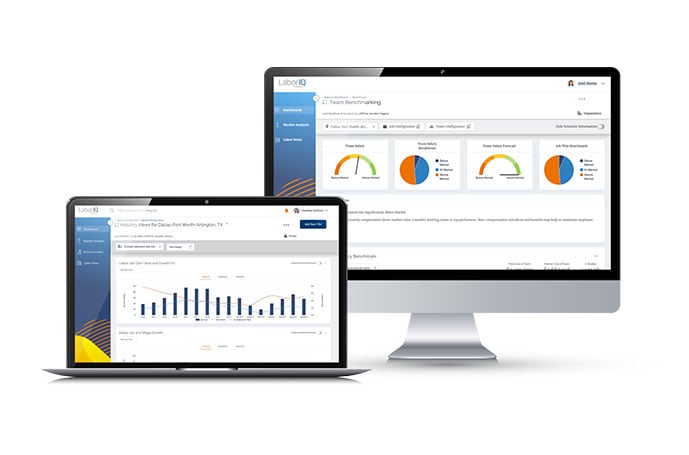
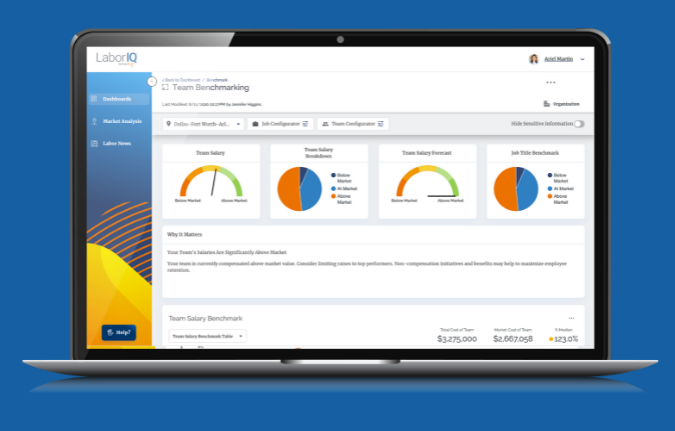
Two of the four failures are solved by having somewhere for the answer to point. LaborIQ is built to be that place: figures come from records that carry a source and a computation date, so an assistant handing one back has something to cite rather than something to reconstruct.
| LABORIQ PLATFORM Compensation Data an Answer Can Cite ✓ Figures that come from records rather than from patterns learned in training ✓ A source and a computation date that can travel with the number ✓ Job matching you can inspect, which is the failure a connection does not fix ✓ Coverage of more than 20,000 unique job titles across 1,600 industries ✓ Validated against real company payroll records, not text scraped from the web → Request a Free Demo at laboriq.co/request-demo |
To check a role against current market data directly, start with Salary Answers.
Frequently asked questions
Can I use an AI assistant for compensation research?
Yes, for framing, structuring and explaining. Treat it as a capable colleague who has read widely and has no access to current market data unless you give them some. The reasoning is often useful even where the figures are not.
Why does the assistant give a different number each time I ask?
Because it is generating a plausible answer rather than retrieving a stored one. Small differences in how you phrase the question change which patterns dominate. A number that moves when the wording moves was never a lookup.
Does connecting a data source make the answers correct?
It makes them sourced and current, which removes two of the four failures described here. It does nothing about whether the job was matched correctly or about the confident tone in which a shaky answer is delivered. Those stay with the person reading the answer.
How can I tell whether an answer used live data or memory?
Ask where the figure came from and when it was last updated. A connected answer can name the source and the date. An answer from memory will either decline, or produce a source that sounds right and cannot be checked.
Is the problem that the model was trained on bad salary data?
That is part of it and it is not the whole picture. Even a model trained on excellent data would still be answering from a fixed snapshot, would still have no source to cite, and would still sound equally confident about a role it matched loosely.
Should I stop using AI for pay questions entirely?
That is an overcorrection. The failures described here are specific and each has a check that takes seconds. Knowing what the four are is more useful than avoiding the tool, particularly since the people around you will use it either way.
Who in the organization should know about this?
Anyone who quotes a salary figure in a conversation, which in practice means recruiters and hiring managers as much as the compensation team. The failures are hardest to catch when the person repeating the number was not the person who asked for it.