
Choosing a compensation data provider is one of the few procurement decisions in human resources where the wrong answer stays invisible for a long time. Software that does not work announces itself within a week. Salary data that is quietly wrong keeps producing confident numbers, and nobody notices until offers start getting declined or a pay equity review turns up differences that nobody can explain.
That delay is what makes the evaluation worth doing carefully. This guide sets out the questions that separate providers, what a strong answer to each one sounds like, what a weak answer sounds like, and how to score the result rather than argue about it.
What you will find in this guide
- What you are buying when you buy compensation data
- Why most provider evaluations compare the wrong things
- The five questions that separate one provider from another
- How to score the answers instead of arguing about them
- Six answers that should end the conversation
- What to settle before you sign
- Running the evaluation in four weeks
- How LaborIQ supports a provider evaluation
- Frequently asked questions
What you are buying when you buy compensation data
Buyers usually describe the purchase as salary numbers. That is the output, not the product. What you are buying is a chain of decisions that ends in a number, and every link in that chain is a place where a provider either does careful work or does not.
| DEFINITION: COMPENSATION DATA A compensation data product is a method, expressed as a number. Someone decided where to collect pay information, how to verify it, which job it belongs to, how to group it geographically, how to age it forward to today, and how to cut it by industry and size. The figure you see is the last step of that chain, and it inherits every judgment made earlier in it. |
Once you see the purchase that way, the evaluation gets simpler. You are not comparing figures. You are comparing five decisions, and asking which provider can describe theirs without reaching for marketing language.
| Link in the chain | What the provider decided | What you inherit |
| Collection | Where pay information comes from and how it is verified | The floor on how accurate any figure can be |
| Job matching | Which internal role maps to which benchmark | Whether the number describes your job at all |
| Geography | How markets are drawn and priced | Whether a metro figure is measured or estimated |
| Aging | How a figure is carried forward between collections | How much of the number is observation and how much is projection |
| Cuts | How industry, size and level slices are formed | Whether a slice has enough behind it to mean anything |
Why most provider evaluations compare the wrong things
Almost every evaluation starts with the two attributes that are easiest to put in a spreadsheet: price, and the number of job titles covered. Both are visible on a website. Neither predicts whether the data will hold up when a candidate declines an offer and a hiring manager asks where the range came from.
Coverage counts are particularly misleading. A provider claiming a very large title library is telling you about the breadth of its taxonomy, not about the depth of evidence behind any single entry in it. The question that matters is not how many titles exist in the catalogue. It is how many observations sit behind the twenty titles you employ most.
| COMMON FAILURES The evaluation team compares three providers on price and title count, picks the one in the middle, and discovers eighteen months later that the roles it prices most confidently are the generic ones the company barely hires for. The specialist roles that drive the salary budget were modeled, not measured, and nobody asked. |
There is a second reason evaluations drift. Demos are built to be persuasive, and the roles a provider chooses to show you are the roles it prices well. Insisting on your own role list, including the awkward ones, changes the conversation more than any question you can ask.
The five questions that separate one provider from another
These five questions do the work. Each one has an answer that a careful provider gives readily and an answer that a weaker one deflects, and the deflections are more informative than the claims.
Question one: where does this number come from?
Ask the provider to describe the underlying source and how it is verified, in plain terms. A strong answer names the mechanism and is specific about what is measured directly and what is inferred. A weak answer leans on the word proprietary and moves on. Provenance is not a trade secret; the algorithm may be, but where the evidence comes from is a fair question. If you want the argument for why this question sits first, our write-up of the risks of crowd-sourced compensation data covers what happens when it goes unasked.
Question two: how old is this number when I see it?
There are two different dates in play and providers sometimes blur them. One is when the underlying pay information was collected. The other is when the figure you are looking at was last recomputed. A published date on a page tells you neither. Ask both, for a specific role, and watch whether the answer arrives as a date or as an adjective.
| What you asked | A strong answer | A weak answer |
| When was this figure last recomputed | A date, and a stated cadence you can hold them to | Regularly, or continuously, with no date attached |
| When was the underlying pay information collected | A collection window, and what happens between windows | The same answer as the previous question |
| What happens to this role between collections | A named aging method and what it is based on | The figure is always current |
Question three: what exactly was matched to what?
A benchmark is only as good as the match behind it, and matching is the step where a plausible number becomes the wrong number. Ask to see the benchmark job description the provider matched your role to, not the title. Titles travel badly between organizations; scope does not. If the provider cannot show you the description, you cannot disagree with the match, and a match you cannot audit is a match you are taking on faith.
Question four: how local is local?
National figures conceal a great deal, and the concealment is not uniform. Some roles price within a narrow band across the country and some vary sharply by market. Ask whether your metro is priced from observations in that metro, or derived by applying a differential to a national figure. Both approaches are defensible and they are not the same thing, and a provider should be able to tell you which one produced the number in front of you.
Question five: what sits behind this number?
Finally, ask how many observations support the specific figure being quoted, not the database as a whole. Providers who report this readily are giving you a way to judge which of their numbers to lean on and which to treat as directional. Providers who treat the question as impolite are asking you to trust a point estimate with no sense of how firm it is.
| KEY TAKEAWAY Every one of the five questions is answerable in a sentence by a provider who does the work carefully. None of them require disclosing anything commercially sensitive. A provider who cannot answer them is not protecting a trade secret; they are telling you the answer would not help their case. |
How to score the answers instead of arguing about them
Five open questions across three vendors produce fifteen paragraphs of notes and, usually, a disagreement about which vendor sounded more convincing. Scoring turns that into a decision. Give each question a weight before you speak to anyone, so the weighting reflects your priorities rather than the last conversation you had.

Score each answer from one to five on how specific it was, multiply by the weight, and total it. The number itself is not the point. The point is that a low score always traces back to a named question, so the debate becomes a discussion about that question rather than about which vendor felt better in the room.
| Score | What that answer looked like |
| 5 | Specific, with a date, a method or a figure, given without prompting |
| 3 | Directionally clear but general, and required a follow-up question |
| 1 | Deflected to marketing language, or answered a different question |
The scoring also settles the argument that tends to derail these decisions. When two people in the room disagree, they are usually weighting the questions differently rather than hearing the answers differently. A recruiter who has watched offers fall apart will weight geography heavily. A compensation lead preparing for a pay equity review will weight provenance and sample transparency. Both positions are reasonable, and writing the weights down before the demos makes that disagreement visible early, when it can still be resolved on its merits.
Six answers that should end the conversation
Most weak answers are worth probing. A small number are not, because they reveal something structural rather than a gap in the room. These six are worth treating as disqualifying unless the provider corrects the record quickly.
| What you hear | Why it is disqualifying |
| Our methodology is confidential | Provenance and method are different things. Only one of them is a secret. |
| Our data is always current | Nothing is always current. This answer replaces a date with a reassurance. |
| We cover every job in the country | Coverage claims of this shape describe a taxonomy, not evidence. |
| Sample size is not something we disclose | You are being asked to treat every figure as equally firm. |
| We can match any title you send us | Matching everything and matching well are different achievements. |
| Other clients do not ask that | This is a comment about other buyers, not an answer about the data. |
| IMPORTANT None of these six are disqualifying because the underlying position is indefensible. They are disqualifying because a provider who is comfortable giving a non-answer during a sales process will be less forthcoming after the contract is signed, when you need a straight answer about a number you have already acted on. |
What to settle before you sign
The data questions decide which provider you want. A separate set of questions decides whether the arrangement will still work in year two, and these are easier to negotiate before a signature than after one.
| Term | What to settle | Why it matters later |
| Refresh commitment | The cadence, written into the agreement | Turns a marketing claim into an obligation |
| Role additions | What happens when you hire into a job you did not license | Growth should not trigger a renegotiation |
| Match review | A route to challenge and correct a match | A wrong match is otherwise permanent |
| Seat model | Who counts as a user, and what recruiters count as | The most common source of unplanned cost |
| Export rights | What you may keep and reuse internally | Determines whether your own analysis survives a switch |
| Exit | Notice period and what happens to work already produced | A switch is far cheaper when this was agreed early |
The seat model deserves more attention than it usually gets, because it is where budgets quietly break. Compensation teams are small and predictable. Recruiting teams are neither, and if every recruiter who needs to check a range counts as a licensed user, a plan sized for the compensation function will be the wrong size within two quarters. Establish early whether occasional lookups by hiring teams are included, metered, or a separate line item.
One term is worth pushing harder than the rest. A written refresh commitment is the only one of these that converts the single most important data quality claim into something you can hold a provider to. Everything else on this list can be revisited at renewal. Data that turned out to be older than you were led to believe cannot be undone, because you have already made pay decisions with it.
Running the evaluation in four weeks
The evaluation does not need to be long. It needs the right sequence, because the work that makes it useful happens before you speak to any vendor.
| Week | What happens | What it produces |
| One | Assemble a role list of twenty to forty jobs, weighted toward what you hire and pay most, and include the hard ones | The list you will judge everyone against |
| Two | Set the weights on the five questions before any vendor conversation | A scoring frame that a demo cannot move |
| Three | Run the same five questions with each provider, using your own roles | Comparable answers rather than comparable pitches |
| Four | Score, review the low scores together, and settle commercial terms | A decision with a written reason behind it |
The role list in week one carries most of the weight, and it is worth resisting the temptation to keep it tidy. A list of clean, common titles will make every provider look competent, because those are the roles everyone prices well. Deliberately include the hybrid roles, the ones with a title nobody else uses, and the two or three specialist positions that took longest to fill last year. Those are the roles where providers separate, and they are also the roles where a weak benchmark costs you the most.
If you are building this evaluation as part of a wider program, it sits naturally alongside the work described in our guide to running a compensation analysis, and the frame you set here is the same one that supports a compensation benchmarking strategy once a provider is in place.
How LaborIQ supports a provider evaluation
The five questions above are a fair test to put to any provider, including this one. LaborIQ is built to answer them rather than to deflect them: recommendations are validated against 8.6 million real company pay stubs and curated from 18 trillion data points, covering more than 20,000 unique job titles across 1,600 industries.
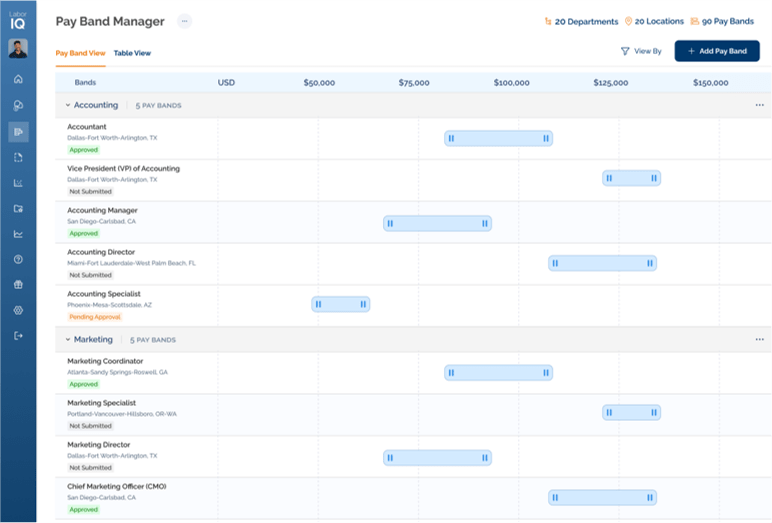
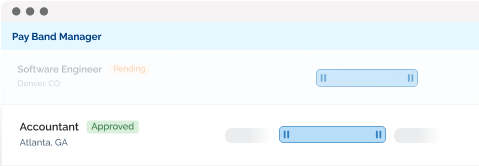
| LABORIQ PLATFORM Compensation Data Built to Be Audited ✓ Salary benchmarks validated against real company pay stubs rather than self-reported entries ✓ Market recommendations for more than 20,000 unique job titles across 1,600 industries ✓ Role matching you can inspect, so a match can be reviewed and corrected ✓ Location-specific pay for remote, hybrid and multi-market teams ✓ Continuously refreshed figures, so a benchmark reflects the current market → Request a Free Demo at laboriq.co/request-demo |
If you want to run your own role list against it as part of an evaluation, Salary Answers is the place to start.
Frequently asked questions
How long should a compensation data evaluation take?
Four weeks is enough for most mid-size employers, and the constraint is rarely the vendors. It is how quickly you can assemble a representative role list and get your own finance and legal reviewers into the room. Evaluations that run for months tend to be waiting on internal scheduling, not on new information.
Should we run a paid pilot before committing?
A short pilot on your own roles is worth more than any demo, because a demo shows you the jobs the provider matches well. Ask to run twenty of your roles, including the three or four that are hardest to classify, and judge the provider on those rather than on the clean ones.
What if two providers give different numbers for the same job?
That is expected, and the difference is information rather than a defect. Ask each one which job description they matched, which geography they priced, how recently the figure was recomputed, and how many observations sit behind it. In most cases one of those four answers explains the gap entirely.
Is more data always better?
No. Volume without provenance is the weakest position a buyer can be in, because a large pool of unverified submissions can be skewed by a small number of outliers. A smaller set of observations you can trace beats a larger set you cannot.
Do we still need a provider if we run our own survey?
Running your own survey answers what your chosen peer group pays, which is a narrow and useful question. It does not tell you what the wider market pays, and it ages from the day it closes. Most employers who run one still buy market data to frame it.
How often should we revisit the decision?
Treat the provider choice as a two to three year commitment and the data quality question as a continuous one. Ask for the same five answers each renewal. A provider whose answers get vaguer over time is telling you something.
Who should be in the room for the evaluation?
Compensation owns the questions, finance owns the commercial terms, and someone from talent acquisition should be there because recruiters live with the consequences of a weak benchmark every week. Security review belongs in the process too if employee data will move in either direction.