
Table of Contents
1. What is a compensation cycle?
| DEFINITION Compensation Cycle A compensation cycle is the structured process organizations use to review, adjust, and communicate employee pay over a defined period. It determines when and how decisions are made around salary increases, bonuses, promotions, and market alignment — and it functions as one of the most critical levers in workforce strategy. |
For most companies, the compensation cycle runs annually and ties closely to performance reviews and budget planning. But the model is shifting. In 2026, organizations are rethinking how rigid their cycles need to be — and whether once-a-year adjustments are enough to stay competitive in a volatile labor market.
A well-designed compensation cycle isn’t just administrative — it’s strategic. It determines whether your pay stays aligned with the market, whether your top performers feel recognized, and whether your cost structure supports long-term growth.
How does a traditional compensation cycle work?
The five core phases of a traditional compensation cycle:
1. Planning phase
Finance and HR define merit increase pools, total compensation budgets, and guidelines for the cycle. This phase sets the boundaries within which all decisions are made.
2. Market analysis
Compensation teams review salary benchmarks, industry surveys, and competitive data to understand how the organization’s pay compares externally. The quality of data here directly determines the quality of decisions downstream.
3. Manager input
Managers recommend raises, bonuses, and role changes for their teams. Without clear guidelines, this phase is the most vulnerable to inconsistency, bias, and budget overruns.
4. Calibration
Leadership reviews all recommendations to ensure internal equity, consistency, and alignment with budget. This is where outliers are flagged and adjustments are made before final approval.
5. Approval and rollout
Final decisions are approved, then communicated to employees. How this communication is handled — with clarity and context — matters as much as the decisions themselves.
Compensation cycle vs. performance review: what’s the difference?
These two processes are often conflated, but they serve distinct purposes. A performance review evaluates what an employee has accomplished. A compensation cycle determines what — if anything — changes about their pay as a result. Decoupling them can actually lead to more thoughtful decisions on both dimensions.
| Dimension | Performance Review | Compensation Cycle |
| Primary purpose | Evaluate contribution and development | Determine and adjust pay |
| Key stakeholders | Manager, employee, HR | Finance, HR, leadership |
| Output | Performance rating, development plan | Salary adjustment, bonus, promotion |
| Must they be linked? | No — many organizations decouple them for better outcomes |
2. Why are compensation cycles changing in 2026?
For decades, the annual compensation cycle was the default — and for most organizations, it worked well enough. But structural shifts in the labor market are exposing the gaps.
| KEY STAT According to Mercer’s Global Talent Trends research, 70% of HR leaders say their current compensation cycle processes are not agile enough to respond to real-time market changes — yet fewer than 30% have moved to a more frequent review cadence. |
The key drivers behind the shift heading into 2026:
- Retention pressure has replaced hiring urgency. As hiring demand cools, the strategic priority has shifted from attracting new talent to keeping the talent you have. Annual cycles are often too slow to address emerging retention risks.
- Pay transparency laws are raising the stakes. Employees in an increasing number of states can now see salary ranges on job postings — including at your competitors.
- Internal equity is a growing legal and reputational risk. Pay equity audits and employee lawsuits around compensation discrimination have increased.
- Distributed workforces demand geographic flexibility. Organizations managing employees across multiple markets need cycles that account for local labor conditions.
- Labor costs are under financial scrutiny. CFOs are demanding more visibility into compensation spend and its relationship to performance.
| KEY TAKEAWAY The compensation cycle is evolving from a once-a-year administrative task into an ongoing strategic process. Organizations that treat it as the latter will have a meaningful advantage in retention, cost management, and talent competitiveness. |
3. What types of compensation cycles do companies use?
There’s no universal model — organizations choose a cycle structure based on their size, industry, workforce complexity, and strategic priorities.
| Cycle Type | Cadence | Best For | Trade-off |
| Annual | Once per year | Mid-to-large enterprises with stable workforces | Slow to respond to market changes |
| Mid-Year Hybrid | Annual + structured mid-year | Competitive talent markets | More process overhead |
| Continuous | Ongoing, data-triggered | High-growth tech, data-mature HR teams | Requires robust tooling & governance |
Annual compensation cycle: still the foundation
The annual cycle remains the backbone of compensation management for most organizations. Its primary advantage is predictability — employees and managers know when decisions will be made, finance can plan budgets accordingly, and HR can coordinate the process systematically.
The limitation is rigidity. A market that shifts in Q2 won’t be addressed until the following cycle begins. High performers who receive competing offers mid-year often can’t wait. And new hires brought in at market rates can quickly create compression issues with existing employees.
Mid-year and off-cycle adjustments: adding flexibility
Many organizations layer mid-year reviews on top of their annual cycles without abandoning core structure. These adjustments are typically reserved for:
- Retaining high performers who have received outside offers
- Correcting roles identified as significantly below market during a benchmarking review
- Adjusting pay for employees who received promotions outside the standard cycle
- Addressing pay compression created by new hire salary levels
| WATCH OUT Off-cycle adjustments require clear criteria and approval processes. Without defined guardrails, they can create new equity issues — for example, only employees who raise concerns receiving market corrections, while others in identical roles do not. |
Continuous compensation model: the emerging frontier
A growing number of data-mature organizations — particularly in technology and high-growth sectors — are moving toward a model where compensation is reviewed on an ongoing basis. Pay decisions are triggered by signals: a market benchmark shift, a performance milestone, a role change, or a retention risk flag.
This approach requires sophisticated tooling and strong governance. But done well, it allows organizations to stay competitive in real time rather than reacting 12 months after a market shift has already cost them talent.
4. What are the key components of a modern compensation cycle?
Regardless of cadence, effective compensation cycles in 2026 share a set of foundational components:
1. Real-time market data
Annual survey data is no longer sufficient as the sole benchmark. Modern cycles incorporate real-time or near-real-time salary data so that decisions reflect current market conditions — not what the market looked like 12 to 18 months ago.
2. Structured salary bands
Pay bands define the range within which roles are compensated. They create the guardrails that allow managers to make recommendations without creating wild inconsistency — and they’re the foundation for any pay equity analysis.
3. Manager guidelines and guardrails
The manager recommendation phase is where most compensation cycles break down. Clear guidelines — including how to use compa-ratios, what triggers qualify for off-cycle adjustments, and how to document decisions — dramatically reduce bias and variability.
4. Geographic pay strategy
Distributed workforces need location-adjusted compensation. Your cycle needs a defined framework for how geography affects pay — and the data to support it.
5. Pay equity and compression analysis
Every cycle should include a review of internal equity — identifying employees whose pay has lagged, roles where new hire rates have created compression, and any patterns that suggest systemic pay disparities.
5. What are the most common compensation cycle challenges?
Even well-intentioned compensation cycles run into predictable problems. Understanding these in advance makes them far easier to address.
| Challenge | Root Cause | How to Address It |
| Delayed decisions | Manual, spreadsheet-based processes | Automate data collection; use compensation platforms to streamline workflows |
| Stale market data | Reliance on annual survey benchmarks | Supplement with real-time benchmarking tools updated throughout the year |
| Manager inconsistency | Lack of clear guidelines and criteria | Develop explicit manager playbooks with guardrails tied to salary bands |
| Pay compression | New hire rates rising faster than merit increases | Build compression audits into every cycle; address proactively, not reactively |
| Cost overruns | Disconnection between merit budgets and actual awards | Model scenarios before the cycle opens; use approval workflows with budget tracking |
| Poor communication | No structured approach to explaining pay decisions | Equip managers with talking points and context; transparency reduces pay anxiety |
6. Annual vs. continuous cycles: which is right for your organization?
There’s no objectively superior cycle model — the right choice depends on your organizational size, HR maturity, budget structure, and the competitiveness of your talent markets.
| Factor | Annual Cycle | Mid-Year Hybrid | Continuous Model |
| HR team size | Any | Small–medium | Medium–large |
| Budget predictability | High | Medium | Lower |
| Talent market responsiveness | Low | Medium | High |
| Process complexity | Low | Medium | High |
| Employee experience | Predictable | More responsive | Most agile |
| Tooling required | Basic | Moderate | Advanced |
| Q: Can we start with an annual cycle and evolve toward a hybrid model? A: Absolutely — and this is the most common path. Most organizations start with a well-structured annual cycle, then introduce defined off-cycle criteria once they have the data and processes to support them. The key is building flexibility into your original framework so that adding mid-year reviews doesn’t require a full redesign. |
7. How do you build a better compensation cycle for 2026?
Building a compensation cycle that actually works in today’s environment requires more than tweaking your existing process:
1. Anchor your cycle to real-time data
The single biggest upgrade most organizations can make is replacing annual survey data with real-time market intelligence. This means benchmarking roles against what companies are actually paying today — not 14 months ago when last year’s survey was fielded.
2. Align the cycle to your business strategy
A company focused on cost optimization will run a different cycle than one focused on aggressive talent acquisition. Define the purpose of your cycle clearly — then build the budget, guidelines, and process to serve that purpose.
3. Build internal equity analysis in from the start
Don’t treat pay equity as an audit you run after decisions are made. Build it into the cycle itself — so that equity gaps are surfaced before increases are distributed, not after.
4. Define clear off-cycle criteria
Decide in advance what qualifies for an adjustment outside the standard cycle. Document the criteria, the approval process, and the budget source. Without this, off-cycle adjustments become ad hoc.
5. Invest in manager capability
Managers are the primary execution point of your compensation cycle. Investing in training — how to use compa-ratios, how to have pay conversations, how to use salary band data — pays dividends in decision quality and employee trust.
6. Use tools that support the full cycle
Manual spreadsheet processes don’t scale and don’t give you the visibility you need. Modern compensation platforms allow you to run the full cycle — from benchmarking to band management to approval workflows — in a single environment.
8. Who benefits most from modernizing their compensation cycle?
Upgrading your compensation cycle structure and tooling delivers outsized value in specific organizational situations:
- Growing companies (50–500 employees) that have outgrown spreadsheet-based processes and need structure before they scale further — establishing salary bands and benchmarking protocols now prevents costly retrofitting later.
- Organizations with distributed or remote workforces that need to manage geographic pay differences at scale, without defaulting to a single national rate.
- Companies experiencing retention challenges in high-demand roles, where the speed of the annual cycle is too slow to respond to competitive offers or market shifts.
- HR teams under resource pressure who need to run a rigorous, defensible compensation cycle without a large dedicated comp team.
- Organizations facing pay equity scrutiny — whether from regulators, employees, or investor ESG requirements — that need a structured, auditable process for compensation decisions.
9. How LaborIQ supports your compensation cycle
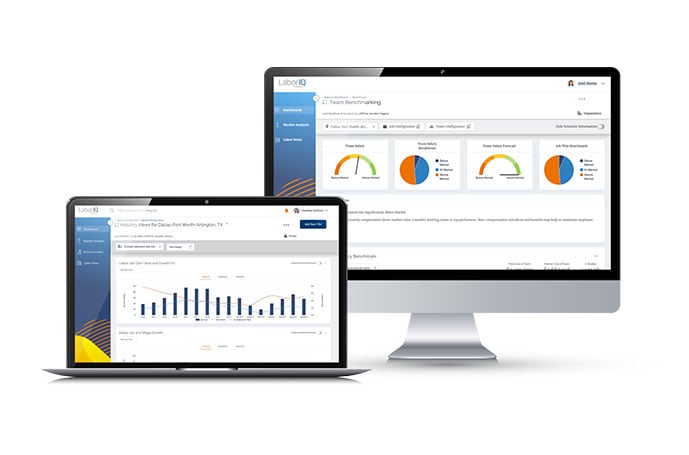
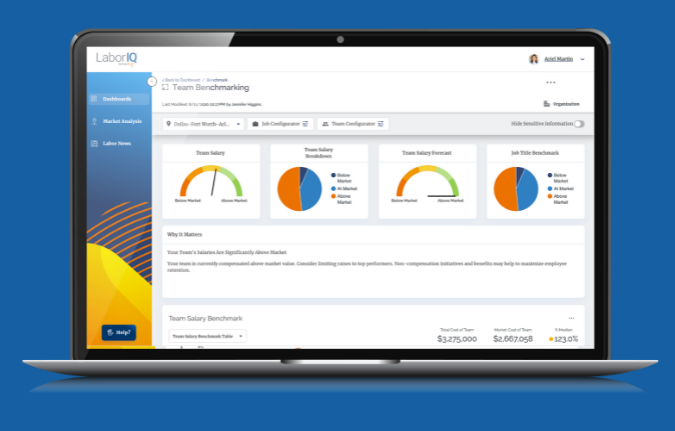
LaborIQ is built to support the full compensation cycle — from initial benchmarking through ongoing pay management — with real-time data and purpose-built tools for HR teams of all sizes.
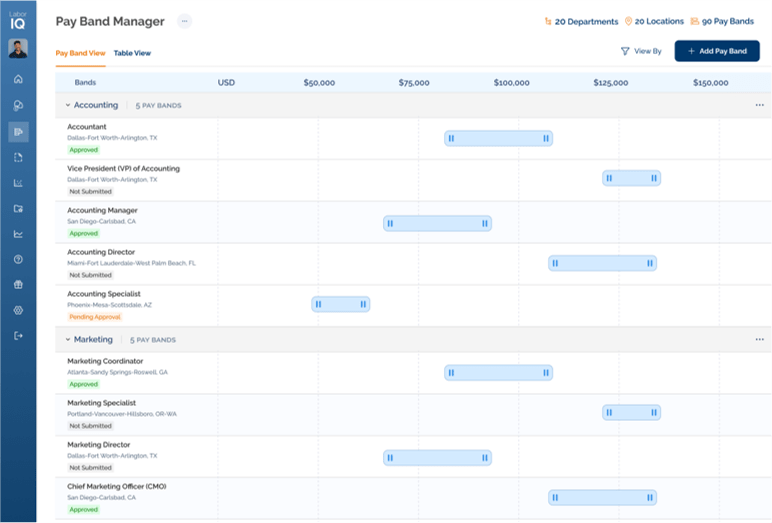
| LABORIQ PLATFORM Run a faster, smarter compensation cycle LaborIQ gives HR teams the real-time salary data, pay band infrastructure, and workforce analytics they need to execute compensation cycles with confidence — without the cost or complexity of enterprise survey subscriptions. ✓ Real-time benchmarks for every U.S. role ✓ Pay Band Manager™ with HRIS integration ✓ Geographic pay adjustment by location ✓ Pay equity & compression analysis ✓ Compensation scenario modeling ✓ On-demand expert compensation advisors→ Request a Free Demo |
When should you use LaborIQ in your compensation cycle?
LaborIQ adds value at every phase:
- Planning phase:Planning phase: Use Salary Answers™ to pull real-time market benchmarks for every role before setting merit budgets — ensuring your pool is calibrated to what the market actually requires.
- Market analysis:Market analysis: Replace or supplement annual surveys with current data by job title, level, industry, and geography — without waiting for a survey cycle to close.
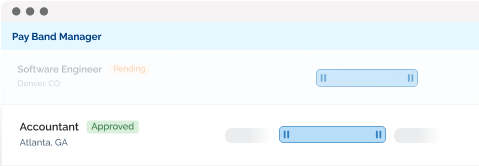
- Calibration:Calibration: Use Pay Band Manager™ to visualize where each employee sits within their band, spot compression risks, and surface equity gaps before final decisions are locked.
- Off-cycle reviews:Off-cycle reviews: Pull market data on demand for any role, anytime — so that mid-year retention or correction decisions are grounded in current data, not outdated benchmarks.
10. Frequently asked questions
| Q: How long does a typical compensation cycle take? A: For most organizations, an annual compensation cycle takes 6–12 weeks from planning kick-off to employee communication. Larger organizations with more complex approval workflows often run 12–16 weeks. Using compensation platforms — rather than manual spreadsheets — is the single biggest factor in reducing cycle time. |
| Q: What is a merit increase pool and how is it determined? A: A merit increase pool is the total budget allocated for salary increases during a compensation cycle, typically expressed as a percentage of total payroll. The pool size is set by Finance based on company performance, market benchmarks, and strategic priorities — then distributed by managers based on individual performance and position within salary bands. |
| Q: What’s the difference between a merit increase and a market adjustment? A: A merit increase rewards individual performance — it’s discretionary and reflects what an employee has contributed. A market adjustment corrects pay that has fallen below competitive levels — it’s driven by external data, not individual performance. Many organizations manage these from separate budget pools to avoid conflating the two. |
| Q: How do you handle pay compression during a compensation cycle? A: Pay compression occurs when newer employees earn close to — or more than — longer-tenured employees in similar roles, typically because market rates have risen faster than internal merit budgets. Addressing it requires a dedicated correction budget, an audit of compa-ratios by role and tenure, and targeted adjustments for the most compressed employees. |
| Q: Should compensation cycles be tied to performance reviews? A: Not necessarily. Many organizations decouple compensation and performance review cycles — running performance reviews mid-year and compensation decisions at year-end, for example. This separation allows employees to focus on development feedback without the distraction of pay outcomes, and gives managers more time to make thoughtful compensation recommendations. |
| Q: How do remote employees affect compensation cycle planning? A: Remote employees introduce geographic complexity into every phase of the cycle. Organizations need a defined policy — do you pay based on the employee’s location, the company’s HQ, or a role-based national rate? — and the data to support it. Location-based pay adjustments require benchmarks at the city or metro level, not just national averages. |
About the Author
LaborIQ Editorial Team
Compensation Research & Strategy · LaborIQ
The LaborIQ editorial team is composed of compensation analysts, HR practitioners, and workforce economists. Our content is grounded in real-time labor market data and reviewed by certified compensation professionals. LaborIQ is a compensation intelligence platform helping organizations benchmark, plan, and optimize pay with confidence.