
Table of Contents
1. What is a compensation philosophy?
| DEFINITION Compensation Philosophy A compensation philosophy is a formal statement of how an organization thinks about and approaches pay, including how it sets salary ranges, positions itself in the labor market, rewards performance, and ensures internal equity across roles. |
At its core, a compensation philosophy answers a deceptively simple question: Why do we pay people the way we do? It’s the foundational document that gives HR teams, hiring managers, and finance leaders a shared framework for pay decisions. Without one, pay is reactive. With one, it’s intentional.
Think of it less as a policy and more as a strategic stance, one that influences everything from job offers to annual merit reviews to how your company communicates pay transparency.
What are the core components of a compensation philosophy?
Most effective compensation philosophies address four core decisions:
- Market positioning Market positioning — Will you lead, match, or lag the market? This single decision shapes your ability to attract talent and your overall payroll cost.
- Pay structure Pay structure — How are salary bands defined? How wide are ranges? Are grades leveled by function or universally?
- Performance alignment Performance alignment — How does compensation respond to individual, team, or company performance? This includes merit increase policies and bonus structures.
- Geographic strategy Geographic strategy — Do you adjust pay by location, or use national rates? As remote work becomes standard, this is one of the most consequential decisions organizations face.
Compensation philosophy vs. compensation strategy: what’s the difference?
These terms are often used interchangeably, but they serve different purposes. Your compensation philosophy is the ‘why’, the values and principles behind how you pay. Your compensation strategy is the ‘how’, the specific programs, tools, timelines, and budgets you use to execute that philosophy.
| Dimension | Compensation Philosophy | Compensation Strategy |
| Purpose | Defines principles & values | Defines execution plan |
| Audience | All stakeholders | HR, Finance, leadership |
| Frequency | Stable, reviewed annually | Updated with market cycles |
| Example output | “We target the 75th percentile for engineering roles” | Salary bands, merit budgets, benchmarking reports |
2. Why does compensation philosophy matter today?
Compensation philosophy used to live in an HR binder, reviewed every few years and rarely consulted. That era is over. In today’s environment, marked by pay transparency laws, talent market volatility, and growing employee scrutiny of fairness, a documented, well-reasoned compensation philosophy has become a competitive necessity.
| KEY STAT Organizations without a formal compensation philosophy are 3× more likely to experience pay equity complaints and face higher voluntary turnover in high-demand roles, according to WorldatWork research on total rewards strategy. |
Here’s why it matters more than ever:
- Pay transparency laws in states like Colorado, California, and New York now require salary ranges in job postings, making it harder to wing compensation decisions ad hoc.
- Candidate expectations have shifted. Most professionals now research pay ranges before applying. If your offers are inconsistent or unclear, you lose trust early.
- Internal equity is under a microscope. Employees compare notes. A clear philosophy, and the pay bands that flow from it, is your best defense against perceived unfairness.
- Market volatility demands agility. Organizations with clear frameworks can adapt faster than those improvising when labor markets move.
| KEY TAKEAWAY A compensation philosophy doesn’t just inform pay decisions, it communicates your values as an employer. Candidates and employees read your approach to pay as a signal of how much you respect and invest in your workforce. |
3. How do you build a compensation philosophy?
Building an effective compensation philosophy is a structured process. It requires input from leadership, HR, and Finance, and it should be grounded in real market data, not intuition.
- Define your business objectives. Define your business objectives. Are you scaling rapidly and need to attract specialized talent? Are you focused on profitability and cost control? Your goals determine your market position.
- Benchmark your roles against current market data. Benchmark your roles against current market data. This means going beyond annual surveys to access real-time compensation data by job title, level, industry, and geography.
- Choose your market position. Choose your market position. Decide whether to lead, match, or lag, and whether that position varies by role type (e.g., leading for engineers, matching for administrative roles).
- Design your pay structure. Design your pay structure. Create salary bands for each role family or level. Define the spread, the midpoint, and how employees progress through ranges.
- Document and communicate. Document and communicate. Write down your philosophy in plain language. Share it with managers and, where appropriate, with employees. Transparency builds trust.
- Review and update regularly. Review and update regularly. Markets change. Your philosophy should be reviewed at least annually and adjusted when the data warrants it.
4. Compensation philosophy examples by industry
There is no one-size-fits-all compensation philosophy. The right approach depends on how a company competes, how fast it grows, what kind of talent it needs, and what it can sustain financially.
| Industry | Market Position | Core Philosophy |
| Technology | Lead (75th pct+) | Equity-forward, above-market base pay, aggressive for specialized roles |
| Healthcare | Match (50th pct) | Internal equity focus, structured bands, compliance-driven |
| Manufacturing | Controlled base + incentives | Efficiency bonuses, tenure-based progression, margin-aware |
| Professional Services | Performance lead | Variable pay emphasis, client outcomes drive bonuses |
| Retail | Standardized scale | Simplified wage tiers, geographic adjustment, scalable |
| Startups / SaaS | Equity-weighted → evolving | Early equity reliance, maturing toward formal bands |
Technology: compete aggressively for specialized talent
Technology companies often adopt a ‘lead the market’ philosophy, positioning base salaries at the 75th percentile or above. The logic: specialized engineering and data talent is scarce, and losing a single key hire to a competitor can cost far more than the salary differential.
Equity compensation is central to the tech philosophy. Options, RSUs, and performance-based equity grants serve a dual purpose, they reduce immediate cash outlay while aligning employees with long-term company performance.
| COMMON PITFALL Many tech companies built compensation philosophies during high-growth periods that are now unsustainable. As the market corrects, these organizations struggle to recalibrate without triggering internal equity issues. A flexible framework with clear band logic makes recalibration far easier. |
Healthcare: prioritize internal equity and compliance
Healthcare organizations take a markedly different approach. Regulatory requirements, licensing structures, and highly defined role hierarchies push these organizations toward structured, predictable compensation systems.
Rather than leading the market, most health systems target the 50th percentile, market match, while maintaining strong internal equity across comparable roles. Pay compression is a major risk in healthcare, particularly when market rates for clinical roles rise faster than internal structures can absorb.
Manufacturing: tie compensation to operational outcomes
In manufacturing, compensation philosophy is closely linked to the production floor. Base pay is competitive but controlled, the real differentiation comes through incentive structures tied directly to output, quality, or efficiency targets.
Tenure-based pay progression is common, rewarding institutional knowledge and reducing turnover among skilled trades. Total rewards, including benefits, shift differentials, and safety bonuses, help compete in tight regional labor markets.
Professional services: reward what you can measure
Law firms, consulting practices, and accounting firms share a compensation philosophy rooted in meritocracy. Base salaries are competitive, but variable pay, bonuses tied to billable hours, client retention, revenue origination, or case outcomes, can represent a substantial share of total compensation.
This model creates clear incentive alignment but demands rigorous performance measurement infrastructure. Without clear, consistent metrics, performance-based pay quickly becomes arbitrary.
Retail: build for scale and simplicity
Retail organizations operate with the highest headcount relative to complexity, which means compensation philosophy must be scalable above all else. Roles are standardized, wage tiers are simple, and progression paths are transparent.
Geographic differentiation has become increasingly critical in retail. A single national wage structure no longer works when labor markets vary dramatically between rural and urban locations. Smart retailers now maintain location-adjusted rates tied to cost-of-labor data.
Startups and SaaS: evolve your philosophy as you scale
Early-stage companies often build compensation philosophy by necessity, not design. Cash is limited, so equity fills the gap. As companies scale past Series B, this philosophy must professionalize, including formal salary bands, a consistent leveling framework, and defensible promotion criteria.
| FOR STARTUPS The best time to build a formal compensation philosophy is before you desperately need one. Getting pay bands in place at 50 employees is dramatically easier, and cheaper, than retrofitting them at 300. |
5. Key comparisons: market positioning and approach
Lead vs. lag vs. match market: which strategy is right?
One of the most consequential decisions in your compensation philosophy is where to position yourself relative to the market. Here’s how each approach plays out in practice:
| Strategy | Market Position | Best For | Trade-off |
| Lead the market | 75th percentile+ | Competitive talent markets, specialized roles, high-growth companies | High payroll cost; requires strong retention ROI |
| Match the market | 50th percentile | Stable industries, strong EVP, mission-driven organizations | May lose top performers to aggressive bidders |
| Lag the market | 25th–40th percentile | Nonprofits, early startups, high-equity organizations | Higher turnover risk; demands strong non-cash offerings |
| Differentiated | Varies by role | Large organizations with diverse role families | Harder to communicate; requires clear criteria |
Many mature organizations use a differentiated strategy: leading the market for revenue-critical or hard-to-fill roles, matching for core functions, and lagging slightly for highly competitive internal roles with strong growth paths.
In-house compensation benchmarking vs. using a SaaS platform
Organizations have traditionally relied on annual salary surveys from consulting firms like Mercer, Willis Towers Watson, or Radford. These surveys are thorough, but they’re expensive, slow to update, and require significant internal resources to analyze.
| Approach | In-House / Survey-Based | Modern SaaS Platform (e.g., LaborIQ) |
| Data freshness | Annual surveys (12–18 month lag) | Real-time or near-real-time |
| Cost | High (survey fees + analyst time) | Subscription-based, lower per-query cost |
| Geographic granularity | Limited; metro-level at best | City- or zip-level benchmarking |
| Ease of use | Requires data expertise | Self-serve; designed for HR teams |
| Pay band creation | Manual in Excel | Built-in tools; HRIS integration available |
| Best for | Large enterprises with dedicated comp analysts | SMBs, growing companies, lean HR teams |
6. Who should define compensation philosophy, and when?
Building a compensation philosophy is a cross-functional effort. Here’s who needs to be in the room:
- Chief People Officer / VP HR: Owns the process, ensures alignment with talent strategy and values
- CFO / Finance: Sets the budget envelope; translates philosophy into headcount cost projections
- CEO / Executive leadership: Approves market position and overall philosophy; communicates it culturally
- Functional leaders: Provide input on role criticality, talent competition, and performance expectations
If you’re at a company with 50+ employees and you don’t have a documented compensation philosophy, now is the right time.
| Q: When should we revisit our compensation philosophy? A: At minimum, annually, ideally timed to your budget cycle so changes can be funded. Also revisit after major hiring surges, M&A activity, geographic expansion, or significant shifts in the labor market for your key roles. |
7. How do you choose compensation software or benchmarking tools?
As compensation philosophy becomes more data-dependent, the quality of your benchmarking tools directly impacts the quality of your pay decisions. Here’s what to evaluate:
- Data recency and methodology Data recency and methodology — How frequently is the data updated? Is it sourced from actual job postings, payroll data, or self-reported surveys? Real-time data is substantially more valuable than annual survey outputs.
- Geographic granularity Geographic granularity — Can the platform benchmark by city, metro, or zip code? National averages are rarely sufficient for distributed or multi-location teams.
- Role coverage Role coverage — Does it cover the specific job families and levels you actually hire for? Generic titles may not capture the nuance of specialized or hybrid roles.
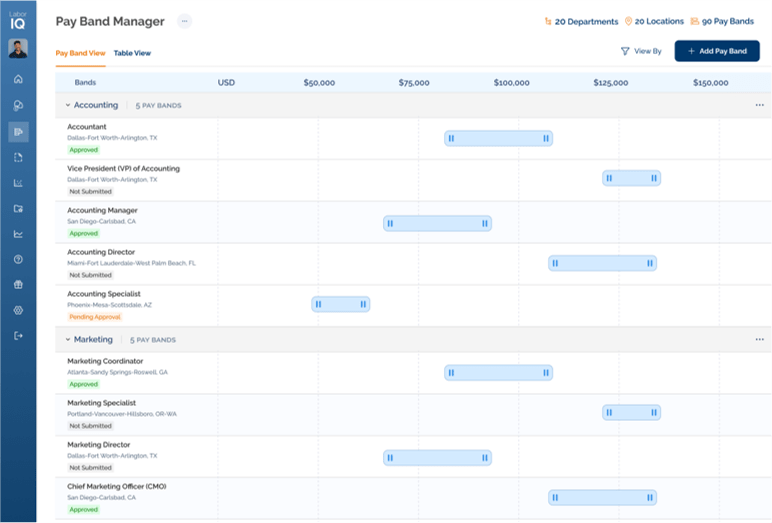
- Pay band and structure tools Pay band and structure tools — Can you move from market data to actual pay bands within the platform? Look for built-in band creation, compa-ratio analysis, and HRIS integration.
- Ease of use for HR teams Ease of use for HR teams — If your HR team is lean, you need a platform that’s self-serve without sacrificing rigor. Evaluate onboarding, support, and user experience alongside data quality.
| Q: How often should we update our salary benchmarks? A: In stable markets, annually is sufficient. In high-velocity markets, like software engineering or nursing, quarterly reviews are worth the effort. The goal is to catch material market moves before they create retention or recruitment problems. |
| Q: What’s a compa-ratio and why does it matter? A: A compa-ratio compares an employee’s actual salary to the midpoint of their pay band. A ratio of 100% means they’re at midpoint; below 80% signals potential underpayment; above 120% may indicate salary creep or a band in need of adjustment. |
8. How LaborIQ supports your compensation philosophy
LaborIQ is built for organizations that want to move beyond static compensation data and actively manage pay decisions in real time. Whether you’re establishing a philosophy for the first time or bringing more structure to a growing company, LaborIQ provides the data and tools to execute with precision.
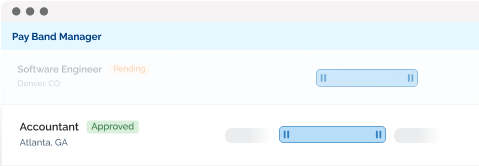
| LABORIQ PLATFORM Turn your compensation philosophy into action LaborIQ provides real-time salary benchmarks, pay band creation tools, and workforce analytics, all designed to help HR teams make faster, fairer pay decisions. ✓ Real-time salary data for every U.S. job ✓ Pay Band Manager™ with HRIS sync ✓ Geographic pay adjustment by location ✓ Pay equity & distribution analysis ✓ Compensation reports in seconds ✓ Dedicated compensation advisor support→ Request a Free Demo at laboriq.co/request-demo |
Who is LaborIQ best for?
- HR teams at mid-market companies (50–2,500 employees) that need professional-grade compensation data without the cost and complexity of enterprise survey subscriptions.
- HR consultants who advise multiple clients and need fast, credible benchmarking across industries and geographies.
- Recruiters and talent acquisition leaders who need to build competitive offers without waiting for a comp analyst.
- Growing startups and SaaS companies formalizing compensation structure for the first time.
When should you use LaborIQ vs. a traditional salary survey?
If you’re making pay decisions on a weekly basis, competing in fast-moving talent markets, or simply don’t have the bandwidth to process a 400-page survey report, LaborIQ is designed for you. LaborIQ is also the better choice when you need geographic granularity, the ability to benchmark a Software Engineer in Austin vs. Denver vs. remote, or a Nurse Practitioner in rural Tennessee vs. suburban Chicago.
9. Frequently asked questions
| Q: What is an example of a compensation philosophy statement? A: Example: “Our company targets the 65th percentile of base salary for all roles, using real-time market data refreshed quarterly. We believe in transparent pay ranges, reward contributions through annual merit increases and performance bonuses, and adjust for geographic differences in cost of labor for remote employees.” |
| Q: What’s the difference between a compensation philosophy and a total rewards strategy? A: A compensation philosophy focuses specifically on pay, salaries, bonuses, and equity. A total rewards strategy is broader, encompassing benefits, professional development, flexible work, recognition, and wellbeing programs. |
| Q: Should we share our compensation philosophy with employees? A: Yes, and increasingly, employees and candidates expect it. Sharing the philosophy builds trust, reduces pay anxiety, and sets clear expectations for how pay decisions are made. In states with pay transparency laws, some of this disclosure is now legally required. |
| Q: How does compensation philosophy affect pay equity? A: A well-designed philosophy with clear pay bands and objective criteria directly supports pay equity. When managers make offers and raises based on documented bands tied to market data, rather than negotiation or gut instinct, the structural conditions for pay gaps shrink significantly. |
| Q: What market percentile should we target? A: Most organizations target between the 50th and 75th percentile for competitive roles. The right answer depends on your budget, your talent competition intensity, and how much of your total value proposition is non-cash. A compensation advisor can help you model the trade-offs. |
About the Author
LaborIQ Editorial Team
Compensation Research & Strategy · LaborIQ
The LaborIQ editorial team is composed of compensation analysts, HR practitioners, and workforce economists. Our content is grounded in real-time labor market data and reviewed by certified compensation professionals. LaborIQ is a compensation intelligence platform helping organizations benchmark, plan, and optimize pay with confidence.