
September 2026 U.S. job market & compensation report: New normal for hiring and pay strategy
September’s jobs report confirms what many HR teams already feel: hiring has slowed, but finding talent hasn’t gotten easier.
The headline numbers
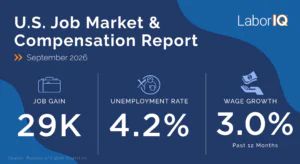
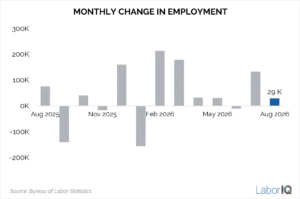
Employers added 29,000 jobs in September, below expectations of around 90,000. The unemployment rate ticked up to 4.2%, and 12-month wage growth ticked down to 3.0%.
Job gains for July and August painted a rosy picture of the labor market. As expected, those hiring totals were revised downward – there were 60,000 fewer jobs added in the last two months than original estimates indicated. These revisions bring the three-month average to 51,000 new jobs.
💡 Revisions tend to be larger during periods of uncertainty – look at three- or six-month trends, not a single report, before making budget or hiring decisions.
The U.S. labor market is holding steady, but steadiness and stability don’t always translate into momentum for businesses or prospects for job seekers. Conditions vary widely by industry and location.
A new normal for job growth
One challenge of explaining the labor market over the past several years is that we are in a period of realignment, redefining the benchmarks for normal or healthy economic metrics.
Historically, 4.5% was the baseline for full employment where nearly everyone that wanted a job had one. Similarly, 2% annual wage growth was the norm for a couple of decades in an era of modest inflation.
Using benchmarks from 2015–2019, especially in compensation planning, will not be a viable strategy going forward.
💡 Compensation leaders wouldn’t price a role using a seven-year-old salary survey. That same logic applies to reading labor market data.
Demographic and migration trends are reshaping job growth
Businesses can hire, either backfilling open roles or creating new positions, from the combined active (unemployed and looking for work) and passive (employed) talent pool.
That talent pool is the U.S. labor force: the population 16 and older who are either employed or unemployed and looking for work. Labor force growth has been flat since early-2025, but recent declines mean the labor force has nearly a million fewer people than it did in September 2025.
Labor force growth has stalled because individuals are aging out of the workforce and international migration has slowed substantially.
The labor force is essentially the ceiling for new job growth. So, when the labor force stops growing, businesses can’t hire beyond that limit, and fewer net job gains are needed to keep unemployment from rising.
Think of job gains as the economy’s backfill number. When the workforce is growing quickly, employers need 100,000 or more new jobs a month to keep unemployment steady. With the workforce shrinking, that backfill number is much lower. A month of 29,000 job gains isn’t strong, but it is also not the warning sign it would have been a decade ago.
💡 With a shrinking talent pool, the easiest hire is the one you keep. Retention and internal mobility are more important than ever. Sectors like healthcare, leisure and hospitality, and construction are most likely to face constraints, and therefore wage pressures, as a result of declining migration.
Industry concentration
Once again, job gains are concentrated in a few industries. Most sectors are treading water.
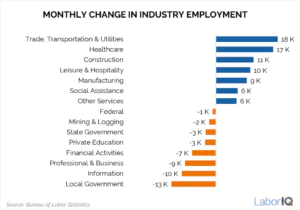
Trade, transportation and utilities (+18,000) posted the largest gain in September, with gains in most subsectors across wholesale trade, retail trade, and transportation.
Healthcare (+17,000) accounted for nearly 60% of jobs added in September and three-quarters of jobs added in the last year. The healthcare industry has supported job growth totals since 2023. Demand for healthcare workers continues to grow as the U.S. population ages. The industry is expected to account for the largest share of new jobs added over the next decade.
Construction (+11,000) has been another bright spot among U.S. industries, bolstered by AI and data center projects. Except for residential specialty trade contractors, all construction subsectors added jobs in September.
Growth in healthcare and construction comes despite slower migration, which makes home health aides, medical technicians, and skilled trade workers harder to find and more expensive to hire.
Employment in private-sector office jobs moved in the other direction. Financial activities (-7,000), professional and business services (-9,000) and information (-10,000) lost a combined 26,000 jobs, nearly offsetting healthcare gains.
💡 Employers in growing sectors face increasing competition for a shrinking talent pool amid growing shortages for front line, care, and skilled trade workers. In many other industries, employers are focused on retaining current staff and budgeting for merit increases despite growing inflation pressures. Either way, plan recruiting and pay strategy by role, not by national averages.
Unemployment remains low
Unemployment rose to 4.2% from 4.1%. The good news is that the unemployment rate rose because of new entrants to the labor force over the past couple of months. When people enter or return to the labor market, they count as unemployed until they’re hired. So, a rising rate can mean more people want jobs, not that more people lost them.
💡 A higher unemployment rate isn’t always bad news. People entered the labor force the last two months looking for work, but not always for the roles that are hardest to fill or in industries that are hiring most frequently.
Compensation is cooling faster than expected
Annual wage growth fell to 3.0% in September, down from 3.1% in August and 3.7% in February. Wage growth has cooled faster than expected this year, while inflation has moved the other way, rising to 3.4%. With prices growing faster than paychecks, real wages are falling.
For HR teams, that creates a squeeze. Employees feel their pay buying less, just as pay budgets are tightening. LaborIQ’s national pay forecasts have come down along with wage growth, but not evenly across roles and levels.
Pay is still rising for some roles where talent is scarce. But more roles may see lower new-hire salaries through 2026 and 2027 as hiring slows across the economy.
What’s driving the slowdown in pay?
Hiring and new job creation have slowed or stalled across most U.S. industries. Job switchers usually get the biggest pay bumps, so when fewer people change jobs, overall wage growth falls.
The good news is that layoffs and unemployment remain low. But this low-hire, low-fire market puts HR and business leaders in a bind: they have to manage tighter budgets amid economic uncertainty while holding on to the people they have. Pay will remain one of the most important retention tools. LaborIQ forecasts average annual wage growth of 3.0% in 2027.
💡 A merit budget that matches the national average won’t keep up with today’s 3.4% inflation. Put increases where they matter most: hard-to-fill roles and the people you can least afford to lose.
What this means for HR and talent teams
A steady labor market isn’t the same as an easy one. Hiring has slowed, the talent pool is shrinking, and pay budgets are tightening just as employees feel prices rising. A few priorities for the months ahead:
- Plan by role, not by the national average. A 3.0% headline hides very different markets. Some roles are scarce and getting more expensive, while others have plenty of candidates. Benchmark the roles and locations you actually hire for, and set realistic timelines for the hardest ones to fill.
- Make retention your first hiring strategy. With fewer workers available and fewer people switching jobs, keeping and developing strong performers is faster and cheaper than replacing them. Build internal mobility into workforce plans now.
- Explain your pay decisions. When raises trail inflation, employees notice. Clear communication about how pay is set, and where your organization is investing, helps keep trust when budgets can’t stretch as far.
- Budget on trends, not single reports. Revisions and data gaps make monthly numbers noisy. Build plans on three- to six-month trends and revisit them mid-year as forecasts update.

LaborIQ provides HR teams and business leaders with market-competitive compensation benchmarks. In an evolving job market, you need to know what salaries to offer to retain employees and fill open positions faster.
Want to hear about how LaborIQ can help your HR team? Learn more