
July 2026 U.S. job market & compensation report: Wage growth meets pay compression
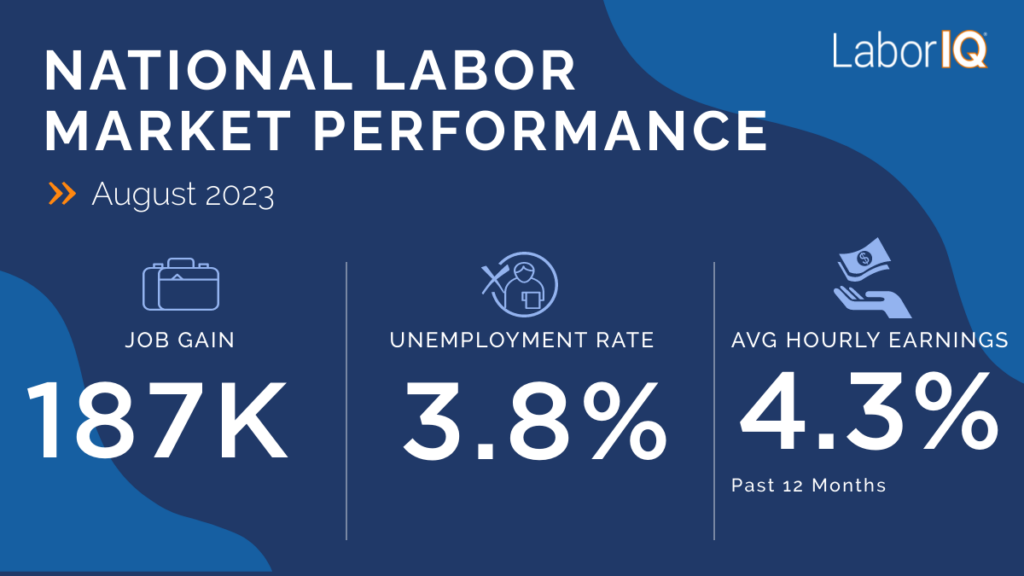
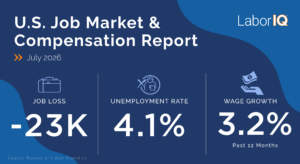
The U.S. economy lost 23,000 jobs in July, well below the more than 80,000 job gains expected. Unemployment ticked down to 4.1%, and 12-month wage growth fell to 3.2%.
This report is noisy – the headline numbers don’t provide a clean narrative. Look past them, and you’ll find reasons for both optimism and pessimism. But the bigger picture hasn’t changed: the labor market has slowed substantially in the last couple of years and headwinds are not subsiding.
Reasons for optimism
- Seasonal factors. Summer creates distortions in education hiring, particularly for teachers. That likely explains most of July’s 49,600 drop in local government education employment.
- World Cup wind-down. The World Cup gave May’s hiring numbers a boost, driven by a surge in leisure and hospitality employment. That extra staffing has started to unwind, the sector shed 40,000 jobs in July.
- Low layoffs and unemployment. Layoffs have stayed near historic lows, declining over the past year. Businesses are showing extreme caution with both firing and hiring decisions.
The case for pessimism
- Labor supply is shrinking. In July, the labor force (people who are either employed or actively looking for work) shrank by 264,000. The number of unemployed workers also declined, but that’s not necessarily good news. Taking both figures together implies that people left the labor force (and are no longer counted as unemployed) likely because they’ve lost confidence in finding work.
- Hiring is concentrated. Outside healthcare, there’s been little hiring momentum, and even healthcare is now showing signs of slower growth. Other sectors – leisure and hospitality during the World Cup, construction amid the AI data center boom – but for most industries, this remains a low-hire market.
What does this report mean for employees?
This report does little to change perceptions of the current labor market. Hiring is low across most sectors, but layoffs have also stayed low. Businesses are holding onto talent and acting with great caution for headcount and expansion decisions.
The biggest confounding factors for business at the moment are wage growth and inflation against the backdrop of slower growth and growing uncertainty.
12-month wage growth declined by more than expected – 3.2% in July compared to 3.4% in June. While 3.2% is robust compared to historical standards, it is lower than workers have experienced since 2019. For workers, this decline in wages comes as inflation is heating up. Workers now face prices outpacing their paychecks in an already uncertain market.
How is reignited inflation creating pay compression in 2026?
Despite the cooling labor market, compensation remains one of the most challenging decisions for HR and business leaders. In particular, wage compression has created challenges as businesses navigate this uncertainty.
Pay compression occurs when there is a relatively small difference in pay between employees across levels of experience, tenure, or skill.
July’s 3.2% wage growth has slipped below June’s 3.5% inflation rate – the first meaningful crossover since the 2021-2022 inflation surge. For workers, that means real wages are effectively shrinking again. For employers, it’s a signal to look harder at how pay is structured internally, not just at what it costs to hire externally.
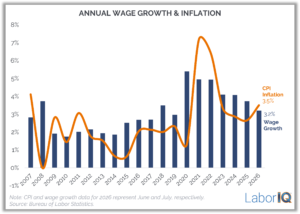
Wages cooling while inflation reheats puts HR and business leaders in an uncomfortable spot: pay decisions made a year or two ago, when hiring was hot and starting pay had to move fast to compete, are now colliding with a slower, more cautious market.
What can HR and business leaders do about pay compression?
With layoffs low, hiring cautious, and wage growth now trailing inflation, this report points to specific, near-term risks rather than a market in crisis. A few takeaways for HR and business leaders:
- Assume pay decisions are already behind the market. Wage growth has cooled to 3.2%, but inflation has returned. Pay bands, comp structures, and merit budgets built around last year’s numbers no longer reflect current conditions.
- Watch for compression building. Low layoffs mean fewer people are moving between employers right now, but the higher starting pay set during the tightest hiring years hasn’t disappeared. Tenured employees who haven’t changed jobs recently can end up earning close to what new hires make, even without anyone leaving.
- Read the shrinking labor force as a retention challenge. July’s 264,000 decline in the labor force suggests discouraged workers are dropping out of the job search rather than finding work. That same discouragement doesn’t stay confined to people looking for jobs. People with jobs face stress right now about the state of the economy.
- Expect retention risk to vary by sector. Hiring momentum outside healthcare remains modest. Workers in industries with little hiring activity have less leverage to leave, while workers in the pockets of concentrated growth have more options and more negotiating power.
None of this points to a labor market in freefall. However, a market where turnover is low and wage growth is losing ground to inflation rewards employers who are working from current data and being proactive in communicating or updating their compensation strategies.

LaborIQ provides HR teams and business leaders with market-competitive compensation benchmarks. In an evolving job market, you need to know what salaries to offer to retain employees and fill open positions faster.
Want to hear about how LaborIQ can help your HR team? Learn more